 Altitude Development Partners
 Inside the virtual currencies, random rewards, and design tactics that turn children’s play into spending.
Roblox does not need roulette tables to reproduce the logic of gambling. A colorful egg that gives a player a random pet can create the same cycle of payment, anticipation, disappointment, and another attempt. These systems are easy to overlook because they appear as mystery boxes, prize wheels, treasure chests, luck boosts, and limited-time collectibles inside games designed to feel funny, social, and harmless.
The gambling-like mechanic is not separate from the entertainment. It is built into the entertainment, which makes it difficult for children—and often their parents—to recognize where play ends and financial persuasion begins.
Roblox is usually described as a video game, but its business model is closer to a combination of YouTube, a game engine, a social network, and an online marketplace. David Baszucki and Erik Cassel founded the company in 2004, and the platform launched publicly in 2006.
Instead of developing every game itself, Roblox gives users a free development tool called Roblox Studio. Creators use it to build millions of games, which the company calls “experiences.” These range from racing and survival games to virtual schools, fashion competitions, obstacle courses, and pet-collecting worlds.
Players move between these experiences with the same account, avatar, friends list, and Robux balance. Roblox controls the platform, currency, payment infrastructure, discovery system, and general rules, while independent creators design most of the gameplay and many of the systems that encourage players to spend.
This structure allows Roblox to offer more content than a traditional game publisher could produce internally, but it also makes oversight difficult. Monetization is not designed by one central team following one consistent standard. It is created by a large, competitive network of developers who need engagement and spending to make their games financially viable.
The scale of that economy is substantial. In 2025, Roblox reported an average of 127 million daily active users and 124 billion hours of engagement. It generated 4.9 billion in revenue and 6.8 billion in bookings, which measure sales activity before certain accounting adjustments. Creators received more than $1.5 billion through the company’s Developer Exchange program. (Roblox 2025 Annual Report)
Roblox is therefore more than a place where children play games. It is a large digital economy built around their attention, social relationships, virtual identities, and purchasing decisions.
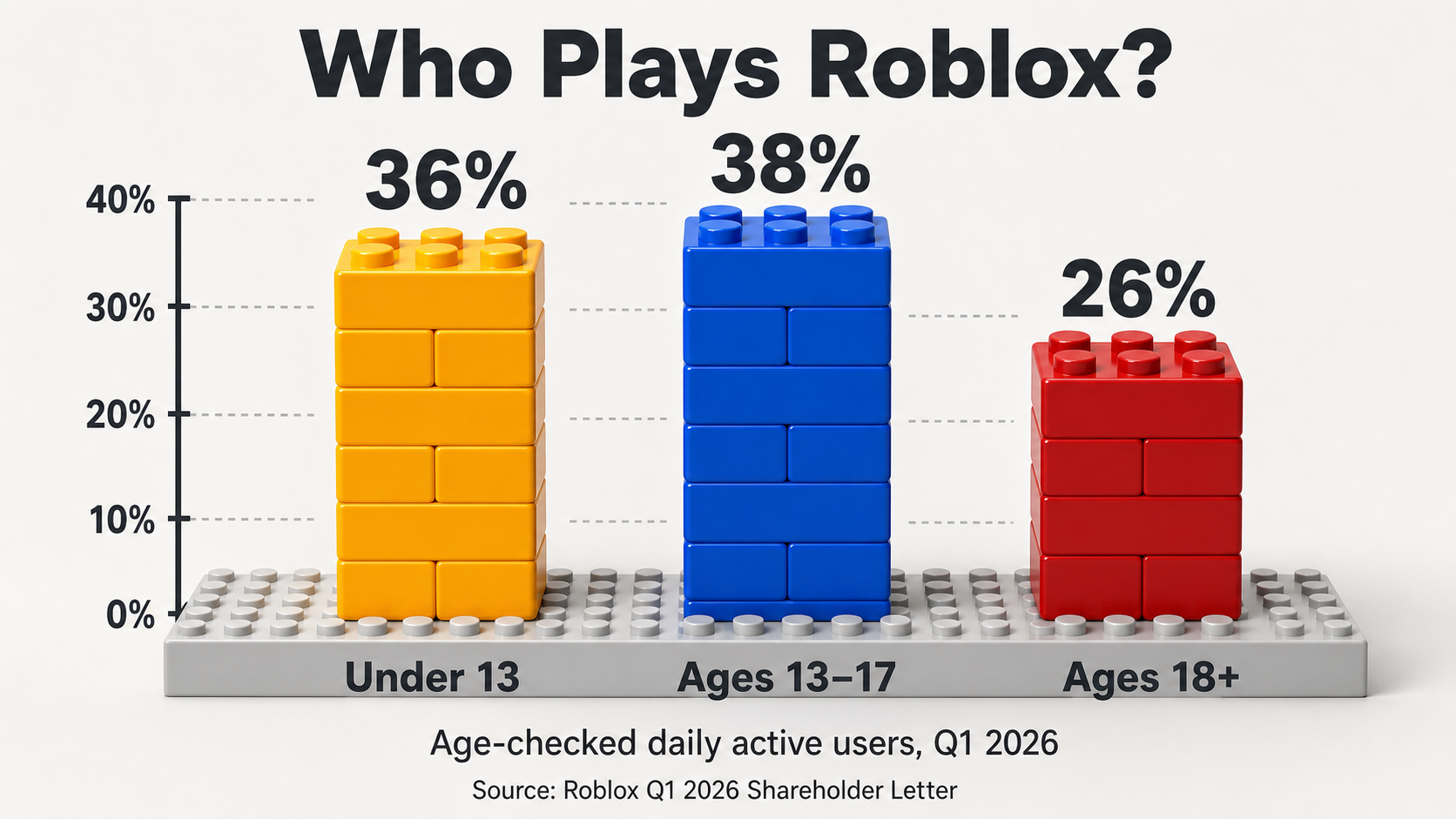 Roblox has historically been known as a children’s platform, and minors still form most of its measured audience. However, the platform is also working to retain users as they grow older and attract adults interested in more complex games.
Roblox began requiring age checks for access to chat in late 2025 and early 2026. By the end of the first quarter of 2026, 36 percent of age-checked daily users were under 13, another 38 percent were between 13 and 17, and 26 percent were 18 or older.
This means that nearly three-quarters of the age-checked audience consisted of minors. Roblox cautions that these figures only cover users who completed an age check and rely on evolving measurement methods, so they should not be treated as a perfect description of the entire platform. (Roblox Q1 2026 Shareholder Letter)
Younger children often enter Roblox through simple controls, recognizable characters, obstacle courses, role-playing, and collecting games. They may not have their own income, but they can receive Robux through parents, subscriptions, prepaid cards, and gifts.
This group is particularly important to the discussion about gambling-like mechanics because younger children may have difficulty calculating probability, converting virtual currency into real prices, or recognizing when a game is deliberately creating pressure to spend.
Teenagers are more likely to use Roblox as both a gaming platform and a social space. Their spending may be tied to competition, avatar design, group membership, and the status attached to rare items.
A purchase can therefore carry social meaning beyond its practical use inside a game. A rare pet or cosmetic item may influence how a player is perceived by friends, classmates, or other members of an online community.
Adults are a smaller but fast-growing part of the audience. Some grew up with Roblox, while others use it to play with family, build games, socialize, or access genres with deeper progression and more demanding gameplay.
This gives Roblox an unusual commercial challenge: it serves very young children and financially independent adults through the same currency and creator economy.
.png) Roblox is free to enter, but its economy depends on a minority of users who purchase Robux. Players can buy the currency directly, receive it through a Roblox Premium subscription, or redeem it from a prepaid card. They then spend Robux on avatar clothing, private servers, game passes, temporary boosts, extra lives, pets, weapons, abilities, and other virtual goods.
Roblox is free to enter, but its economy depends on a minority of users who purchase Robux. Players can buy the currency directly, receive it through a Roblox Premium subscription, or redeem it from a prepaid card. They then spend Robux on avatar clothing, private servers, game passes, temporary boosts, extra lives, pets, weapons, abilities, and other virtual goods.
In 2025, approximately 1.8 million of Roblox’s 127 million average daily users were daily unique payers. Roblox reported average daily bookings of 10.36 per daily payer, compared with 0.15 when bookings were divided across the full daily audience. Substantially all company bookings came from sales of virtual currency. (Roblox 2025 Annual Report)
Older players are more valuable on an individual basis. In the United States, Roblox says users over 18 monetize more than 50 percent higher than users under 18. The company has responded by offering stronger incentives to developers who produce deeper, higher-quality games for adults. (Roblox, April 2026)
The difference is understandable because adults usually control their payment methods, have more disposable income, and can make purchases without parental approval. They may also be more willing to pay for subscriptions, long-term progression, private servers, competitive advantages, or cosmetic items connected to a persistent online identity.
Children remain commercially important even if they spend less per person. They represent most of the age-checked audience, and their scale gives them considerable influence over the Roblox economy. They also influence family spending through gift requests, prepaid cards, subscriptions, and repeated requests for Robux.
Public reports do not show exactly how much every child, tween, and teenage group spends. Claims that one specific minor age group spends the most are therefore difficult to verify. The available evidence supports a more careful conclusion: adults generate more value per user, while younger players remain the foundation of Roblox’s reach, engagement, and culture.
Traditional gambling generally contains three elements: the player gives up something of value, chance determines the result, and the player may receive a prize with value. Some Roblox systems closely resemble this structure because players can buy Robux, convert it into another game currency, and spend that currency for a chance to receive a rare item.
The legal position is less straightforward. In many jurisdictions, a random digital reward may fall outside gambling law when it cannot officially be converted back into money. The United Kingdom, for example, considers the absence of a legitimate cash-out mechanism an important distinction between gambling and most loot boxes.
The same UK review found a stable association between loot-box use and problem gambling, but it did not establish whether loot boxes cause gambling problems, people with existing gambling problems spend more on loot boxes, or both behaviors share other risk factors. (UK Government loot-box review)
This creates a gap between legal classification and player experience. A system may fall outside a country’s statutory definition of gambling while still using payment, uncertainty, anticipation, loss, and repeated attempts to influence behavior.
Discussions about gambling in Roblox also tend to combine three separate issues.
Paid random items include mystery eggs, prize wheels, treasure chests, card packs, loot boxes, random upgrades, and other purchases with uncertain outcomes.
The player may spend Robux directly or use Robux to buy a second currency that later pays for the random reward. Roblox treats both arrangements as paid random-item systems.
Simulated gambling includes experiences designed to resemble casinos, betting, roulette, or slot machines, even when the player cannot win real money.
This category concerns the presentation and activity itself. A game may imitate gambling without allowing players to withdraw their winnings or convert them into real-world currency.
Third-party Robux gambling takes place outside the official Roblox platform. External websites have allegedly allowed users to deposit Robux or related credits and then place wagers on casino-style games.
A 2023 proposed class action accused Roblox of helping facilitate this activity. Roblox responded that the named gambling sites were independent services with no legal affiliation to the company. (Ars Technica)
These three categories are not legally or technically identical, but each demonstrates how easily the boundary between play, virtual property, and wagering can become unclear.
.png) Randomized monetization became common across video games during the 2010s. Roblox developers adapted the model through weapon crates, mystery gifts, collectible pets, random upgrades, and prize wheels. By July 2019, these systems were common enough for Roblox to introduce a formal requirement that developers disclose the numerical odds of every possible paid random reward.
Randomized monetization became common across video games during the 2010s. Roblox developers adapted the model through weapon crates, mystery gifts, collectible pets, random upgrades, and prize wheels. By July 2019, these systems were common enough for Roblox to introduce a formal requirement that developers disclose the numerical odds of every possible paid random reward.
The rule covered direct purchases and more complicated systems. If a player bought a virtual coin with Robux and later spent that coin for a random item, the developer still had to disclose the odds before the transaction. (Roblox Developer Forum, July 2019)
The same period also produced one of Roblox’s most effective child-friendly versions of the loot box. Adopt Me! introduced collectible pets in 2019, and its economy increasingly revolved around eggs, rarity, collection, and trading.
The egg changed how the transaction felt without changing its underlying structure. A military-style loot crate looks like a commercial product, while a colorful egg feels like part of a story about adopting or discovering a pet. The player does not feel as though they are placing a wager because the payment is presented as an act of play.
Concern expanded during the following years. By 2023, lawsuits were examining third-party virtual casinos connected to Robux. In 2025 and 2026, researchers began publishing broader evidence about how deeply monetization had entered popular Roblox experiences.
The most defensible conclusion is that gambling-like mechanics grew out of Roblox’s mid-2010s creator economy, were firmly established by 2019, and became more difficult to separate from ordinary play as collecting and simulator games gained popularity.
.png) These mechanics are rarely hidden from the software. They are hidden from the player’s understanding through friendly language, layered currencies, social pressure, and game design that makes spending feel like a natural part of progress.
These mechanics are rarely hidden from the software. They are hidden from the player’s understanding through friendly language, layered currencies, social pressure, and game design that makes spending feel like a natural part of progress.
Language changes how children interpret a transaction. “Buy a loot box” sounds commercial, while “hatch an egg,” “open a gift,” or “summon a character” sounds like an action within a story.
The reward is often represented as a character rather than a product. A child may feel that they are adopting, rescuing, or discovering a pet, even though they are purchasing a probability. The emotional framing reduces the distance between wanting the character and paying for another chance to receive it.
A purchase may pass through several layers before producing a reward:
Dollars → Robux → gems → spin ticket → random item
Every conversion makes the real price harder to calculate. Instead of asking whether a pet is worth five dollars, the player begins thinking about whether they have enough gems for another attempt.
A University of Sydney study involving children aged 7 to 14 found that young players struggled to understand conversions between real money, Robux, and currencies used inside individual games. Some described the systems as confusing or frightening. (University of Sydney, 2025)
Currency bundles create additional confusion because players are often required to buy more currency than a particular item costs. The remaining balance encourages another purchase, while the next desired item usually requires the player to buy another bundle.
A guaranteed purchase ends when the buyer receives the item. A random purchase can continue because the player is not buying the desired reward itself; they are buying another opportunity to receive it.
Roblox’s creator documentation places pet eggs, prize wheels, loot chests, luck boosts, rate-up systems, and “pity” systems within its rules for paid random items. Developers must disclose probabilities and restrict access for users in locations where these mechanics are prohibited. (Roblox Creator Hub)
Accurate odds improve transparency, but they do not remove the emotional force of the system. A child may understand that a rare item has a 1 percent probability and still believe that repeated attempts make the next result feel more likely.
Random rewards are often surrounded by rising music, bright colors, shaking objects, and scrolling images of possible prizes. The animation may slow near a rare item before stopping on a common reward, creating the impression that the player almost won.
This near-miss presentation can turn disappointment into motivation. Although each attempt may be independent, the player leaves with the feeling that success is getting closer and another purchase may complete the process.
Roblox’s social environment increases the value of virtual items because players display avatars, pets, weapons, homes, and collections in front of friends and strangers. A rare item can communicate luck, wealth, experience, taste, or membership in a desirable group.
Trading systems strengthen this effect by giving items a perceived market value. When classmates or friends own a rare pet or cosmetic item, not having it can feel like social exclusion rather than a simple purchasing decision.
Many purchases appear at the moment a player experiences a loss. A game may offer a paid revive after death, a shortcut past a difficult stage, additional inventory when storage becomes full, or a luck boost after the player repeatedly fails to receive a rare reward.
These purchases do not merely add content. They remove friction deliberately placed inside the game, which allows developers to create inconvenience and then monetize the relief from that inconvenience. The timing also matters because a frustrated player is less likely to evaluate the purchase calmly.
Limited-time eggs, seasonal pets, rotating stores, countdowns, and daily streaks add urgency to transactions. The player is not simply deciding whether an item is worth buying; they are being told that waiting may cause the opportunity to disappear.
This pressure is particularly effective when the item is connected to a collection. A child who has collected most of a set may view the missing limited item as an unfinished task rather than an optional purchase.
Recent studies suggest that these design patterns are common across popular Roblox experiences rather than limited to a few unusual games.
University of Washington researchers examined 82 popular Roblox experiences with a fresh account registered as belonging to a child under 13. They found at least one monetization strategy in 82.9 percent of the experiences and at least one strategy matching a definition of deceptive design in 71.9 percent.
More specifically, 51.8 percent contained what the researchers classified as predatory monetization, while 40.7 percent used engagement coercion such as daily rewards. Because the researchers only examined the first view shown after entering each experience, they described the results as a lower bound that may exclude monetization appearing later in gameplay. (“Why Johnny Spent Money on Roblox,” 2025)
A separate University of Sydney report examined 15 popular Roblox experiences in 2026 and found potentially misleading or deceptive monetization in 14 of them.
The researchers documented unclear real-world prices, misleading discounts, pressure following losses, near-miss visuals, limited-time offers, random rewards, and pay-to-progress systems. (University of Sydney, 2026)
These studies do not show that every Roblox experience is harmful, nor do they establish that loot boxes cause gambling addiction. Roblox contains creative, educational, and genuinely social experiences that do not depend on aggressive monetization.
The findings support a narrower but still important conclusion: spending pressure and deceptive design are common enough to form part of the platform’s normal commercial environment.
Roblox formally distinguishes gambling from paid random items. Its creator documentation defines gambling as exchanging real money, Robux, or valuable in-game items for a game of chance. The platform separately permits paid random items when creators disclose the odds and comply with restrictions based on the player’s location and eligibility.
Roblox uses its PolicyService system to determine whether a player may access paid random items or trade items obtained from them. The company has also introduced age checks, content labels, parental controls, and new account structures for younger users.
These protections address some clear risks, but they do not resolve the underlying design problem. Displaying odds does not guarantee that a child understands expected value, while restricting casino simulations does not remove gambling psychology from eggs, prize wheels, and mystery gifts.
The central question should therefore focus on the behavior encouraged by the system rather than its visual theme. If a mechanic invites a young player to exchange money for uncertainty, chase a desired result, and continue spending after disappointment, replacing a slot machine with a cartoon pet does not remove the risk.
Removing every commercial feature from Roblox would be neither practical nor necessary. Creators need ways to fund development, and players can receive genuine value from items that expand, improve, or personalize an experience.
Responsible monetization would begin by showing the real-money price beside every Robux or game-currency price. Games should not be allowed to hide costs behind several paid currencies or force players to buy bundles containing more currency than they need.
Prices, discounts, and limited-time offers should also be verifiable. A game should not claim that an item is discounted when the higher reference price was never meaningfully used.
Paid random rewards should be disabled for minors by default and made available only after active parental approval. Direct purchases with guaranteed outcomes should replace random transactions wherever possible.
Games should not present purchase prompts immediately after a loss or use countdowns to pressure children into making quick decisions. Players and parents should receive clear spending histories, practical limits, cooling-off periods, and accessible refund procedures.
Effective enforcement requires regular audits of popular experiences using accounts assigned to real child age groups. Roblox controls the currency, payment infrastructure, recommendation systems, and technical rules, so responsibility cannot rest only with individual developers or parents.
A parent cannot realistically inspect every currency conversion, probability table, trading market, and reward loop across millions of user-created experiences. The platform that processes and benefits from the transactions is in the strongest position to establish consistent protections.
Roblox succeeds because it gives people accessible tools to create, share, and play together. For many children, it is one of the first places where they build things, manage virtual property, and participate in an online community.
Those benefits make its monetization systems more important to examine, not less. Children encounter gambling-like design while caring for pets, opening presents, racing friends, and exploring colorful worlds. The surrounding entertainment feels harmless, which makes the commercial structure underneath it harder to recognize.
The financial sequence remains real even when the presentation is playful: money becomes Robux, Robux becomes gems, and gems purchase a chance. When the result is disappointing, the game offers another attempt.
The most effective gambling mechanic in Roblox does not need to resemble a casino because it has already been redesigned to look like ordinary play.