 Altitude Development Partners
A private trading firm most people outside finance have never heard of made more money than JPMorgan's entire trading arm in 2025. In July 2026 it lost $15 billion in a single month for the first time in ten years, and the loss had almost nothing to do with the business that made it rich.
On July 31, 2026, a Jane Street partner named Turner Batty sent the firm an internal note containing a sentence that hadn't been true in a decade: July was a bad month. The firm had lost roughly $15 billion in thirty-one days. A decade earlier, that number would have swallowed a full year of the firm's revenue. In 2025 alone, the same firm cleared $39.6 billion in trading revenue, more than JPMorgan's entire trading arm, from about 3,500 people.
Jane Street is a private, employee-owned market maker. It trades its own capital rather than raising money from outside investors the way the other firms in this series do, a distinction precisely defined in What is a Hedge Fund?. It belongs in this series anyway, because of where July's loss came from. A hedge-fund-style bet sitting on top of the firm's core trading business produced the loss. The market-making side kept working the whole time. The gap between a business built to never have a bad month and a bet that just proved it could is the most useful way into everything else about the firm.
Three businesses do almost all of the work: exchange-traded funds, options and other derivatives, and fixed income, roughly in that order of scale. Jane Street is one of the largest authorized participants in the ETF market, the role that creates and redeems ETF shares to keep a fund's price lined up with what it holds. In 2024 the firm handled around 41% of all bond ETF trading volume, close to a quarter of primary-market activity in US-listed ETFs, and about 17% of secondary-market ETF activity in Europe, on average monthly ETF volume near $707 billion. In options, the firm accounts for roughly 8% of all Options Clearing Corporation transactions. In fixed income, the newest and fastest-growing of the three, it averaged around $230 billion in monthly trading volume in 2024, with $260 billion in annual bond portfolio-trading volume, a corner of the market that electronic firms only recently learned to compete in.
None of this involves picking stocks. It involves being willing to quote a price on almost anything, continuously, holding brief inventory risk on both sides of a trade, and being fast and correct enough that the spread between the buy price and the sell price adds up across billions of trades a year. The margins are thin. A single trade might clear a fraction of a cent. Volume is what turns that fraction into $39.6 billion.
It issued debt. In 2025, Jane Street sold $1.35 billion in senior secured notes due 2033 to fund its balance sheet. Selling bonds meant filing a prospectus. That meant giving outside investors real numbers for the first time in the firm's history.
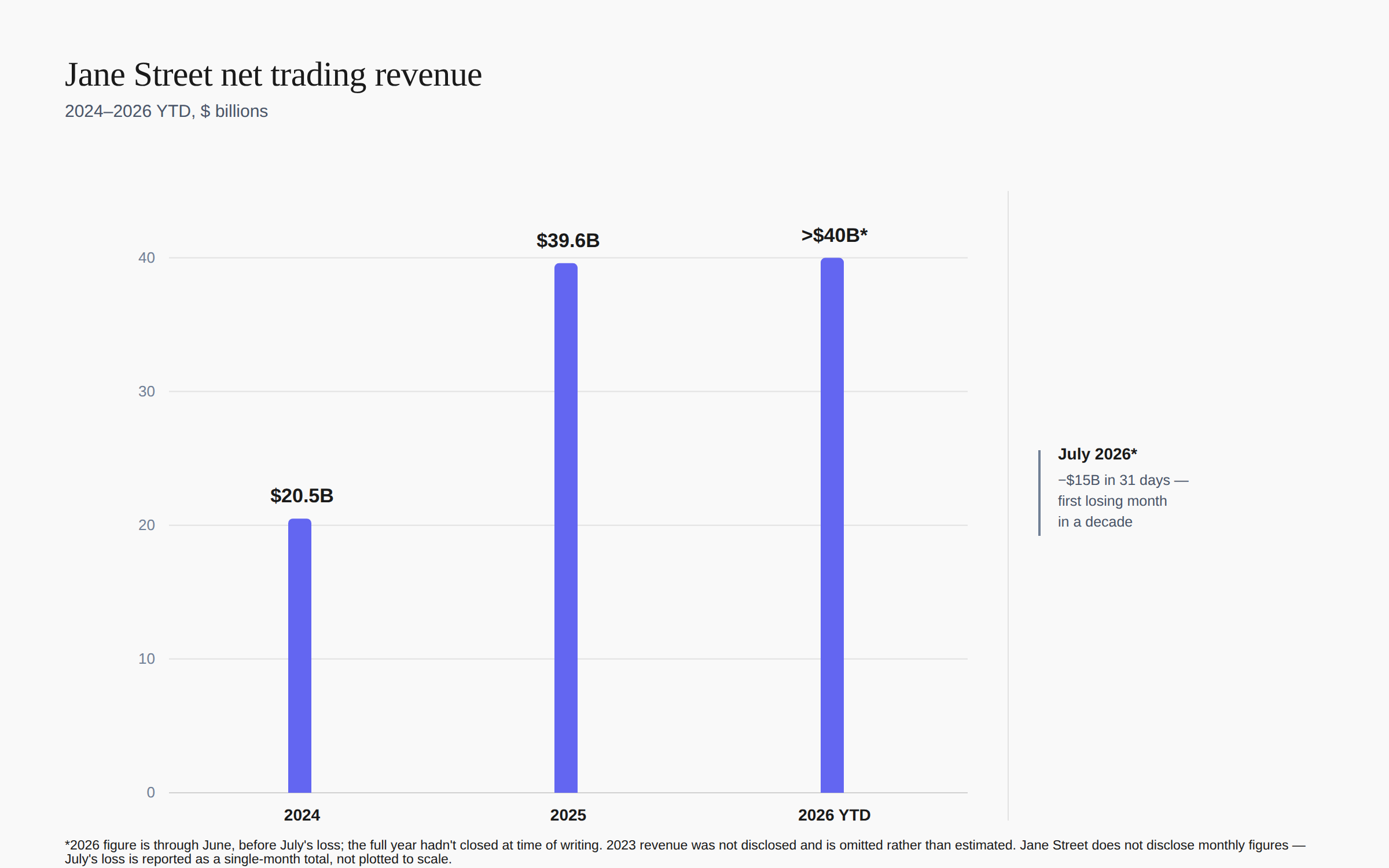
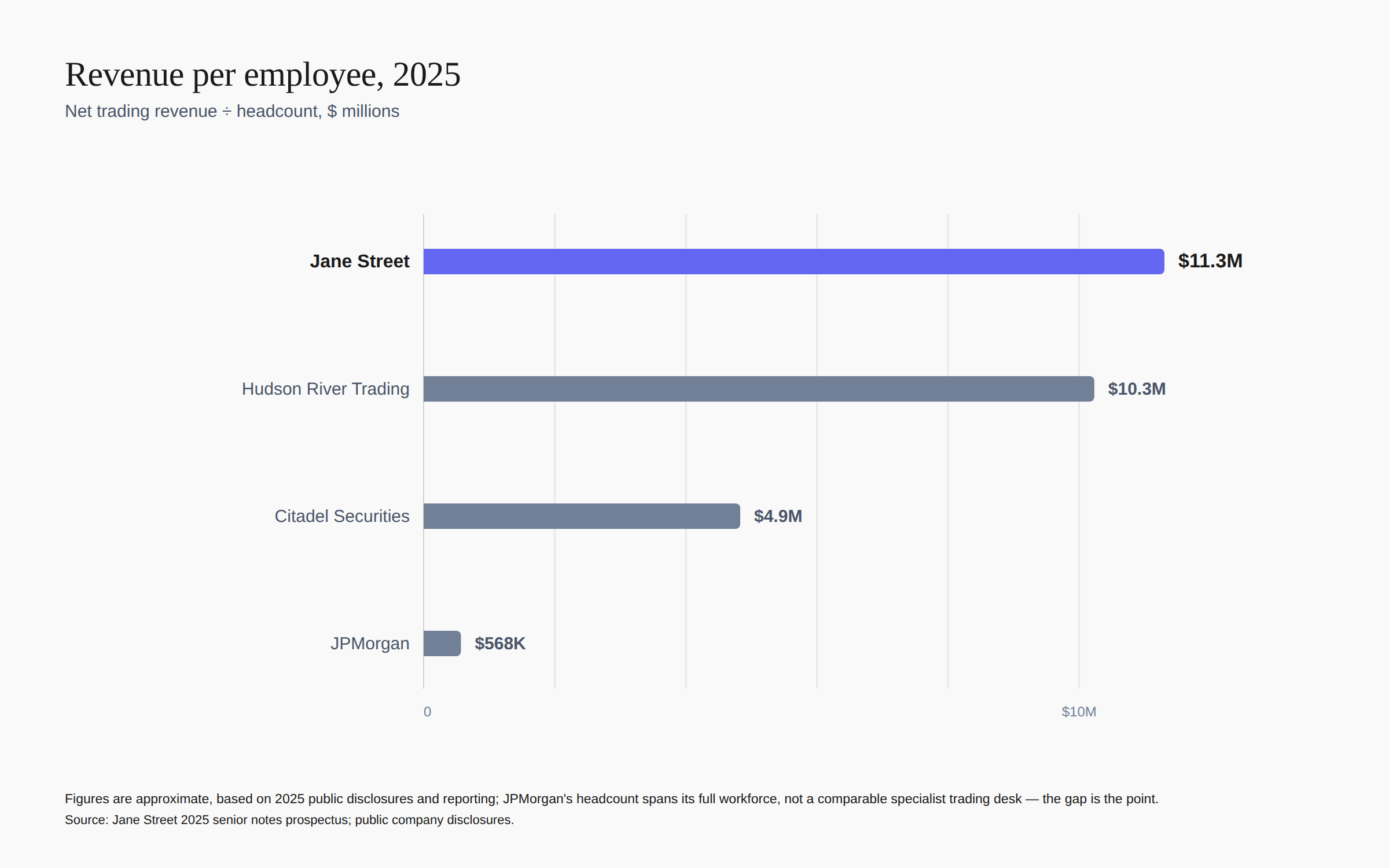
Those numbers are why this piece can run on data instead of reputation. Full-year 2025 net trading revenue came to $39.6 billion, up about 93% from 2024's $20.5 billion. The average Jane Street employee took home $2.68 million that year, out of a $9.38 billion total compensation pool spread across roughly 3,500 people, running at around 20 to 24% of revenue, in line with the firm's historical payout ratio. Members' equity stood near $45 billion, with employees holding about 80% of the firm's own capital. Revenue per employee for 2025 worked out to roughly $11.3 million, against $4.9 million at Citadel Securities, $10.3 million at Hudson River Trading, and $568,000 at JPMorgan. JPMorgan needs nearly twenty Jane Streets' worth of people to get there. The second quarter of 2025 alone brought in $10.1 billion in net trading revenue and $6.9 billion in net profit, a single-quarter record at the time. By August 2026, before July's loss, the firm had already booked more than $40 billion in net trading revenue for the year, ahead of the whole of 2025.
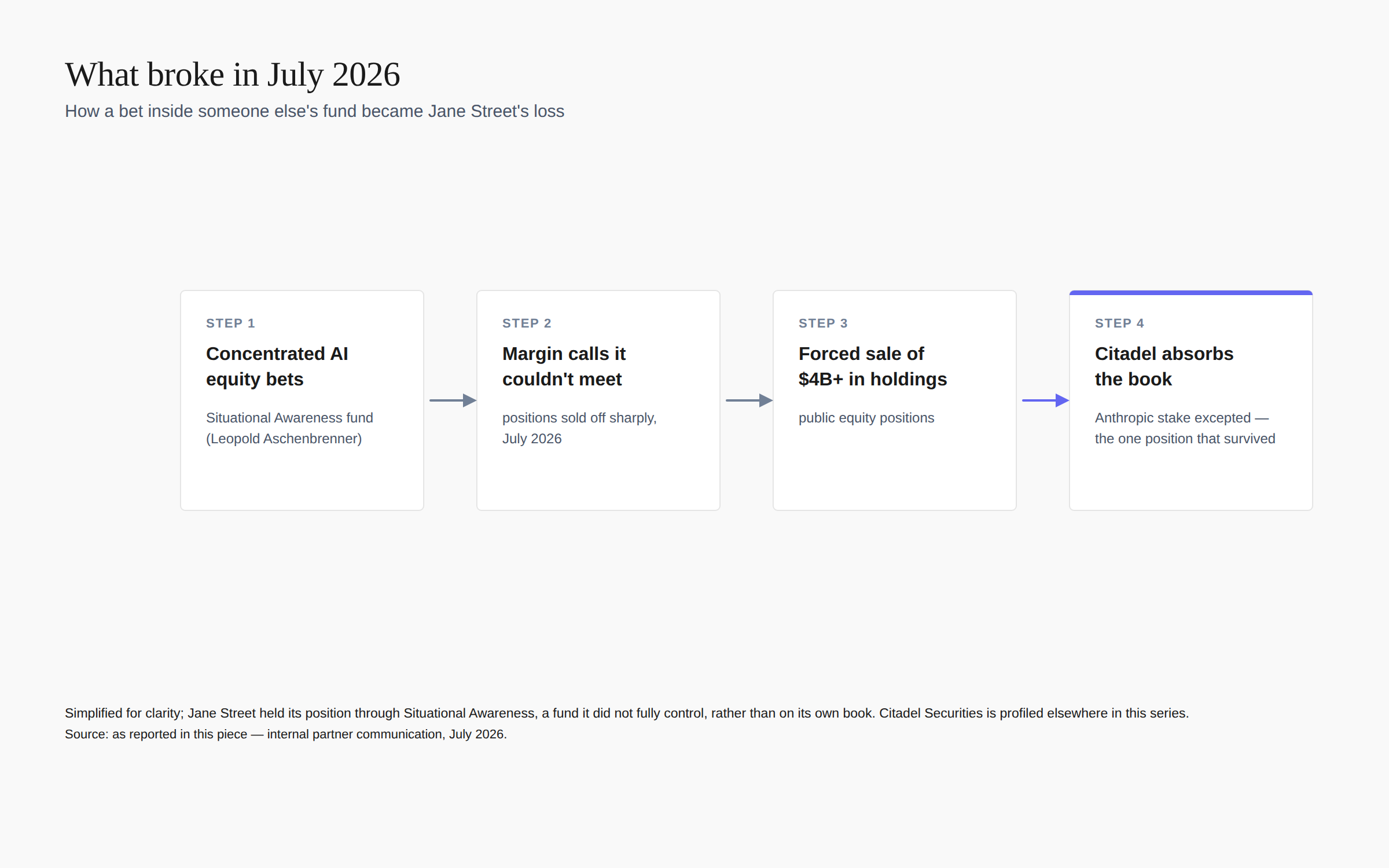
A stake in someone else's hedge fund. Jane Street held a position in Situational Awareness, the AI-focused fund run by Leopold Aschenbrenner, which had built concentrated bets on AI-related equities. When those positions sold off sharply in July, Situational Awareness faced margin calls it couldn't meet on its own, and it ended up handing over more than $4 billion of its public equity holdings to Citadel, profiled elsewhere in this series, which absorbed the position and helped stop a broader forced unwind across AI stocks. Situational Awareness kept exactly one position through the unwind: its stake in Anthropic. Nothing else survived the sale.

"July was a bad month," Batty told staff, in the kind of understatement the firm is known for. By year-end, the Situational Awareness stake itself was reported roughly flat despite the July losses, and the core trading business had recovered enough that 2026 still looked on pace to set a new full-year record. What matters is where the loss came from. Decades of market-making infrastructure did not have a bad month. A large, correlated bet, held through a fund Jane Street didn't fully control and disclosed to the outside world only after the fact, did.
Three live legal and regulatory episodes complicate the story that Jane Street's core business is simply clean. India's securities regulator, SEBI, has accused the firm of manipulating the Bank Nifty index between January 2023 and March 2025, alleging that one Jane Street entity bought large volumes of bank stocks to push the index up while another entity placed derivatives bets that profited from the move. SEBI ordered the firm to deposit ₹4,843.57 crore, roughly $566 million, in alleged unlawful gains; Jane Street paid it in July 2025, and a trading ban was lifted within about a week. The firm has called its activity basic index arbitrage. The case is still open: an appeal to India's Securities Appellate Tribunal was still pending as of a February 2026 hearing, with Jane Street arguing SEBI withheld documentation the firm needed to defend itself.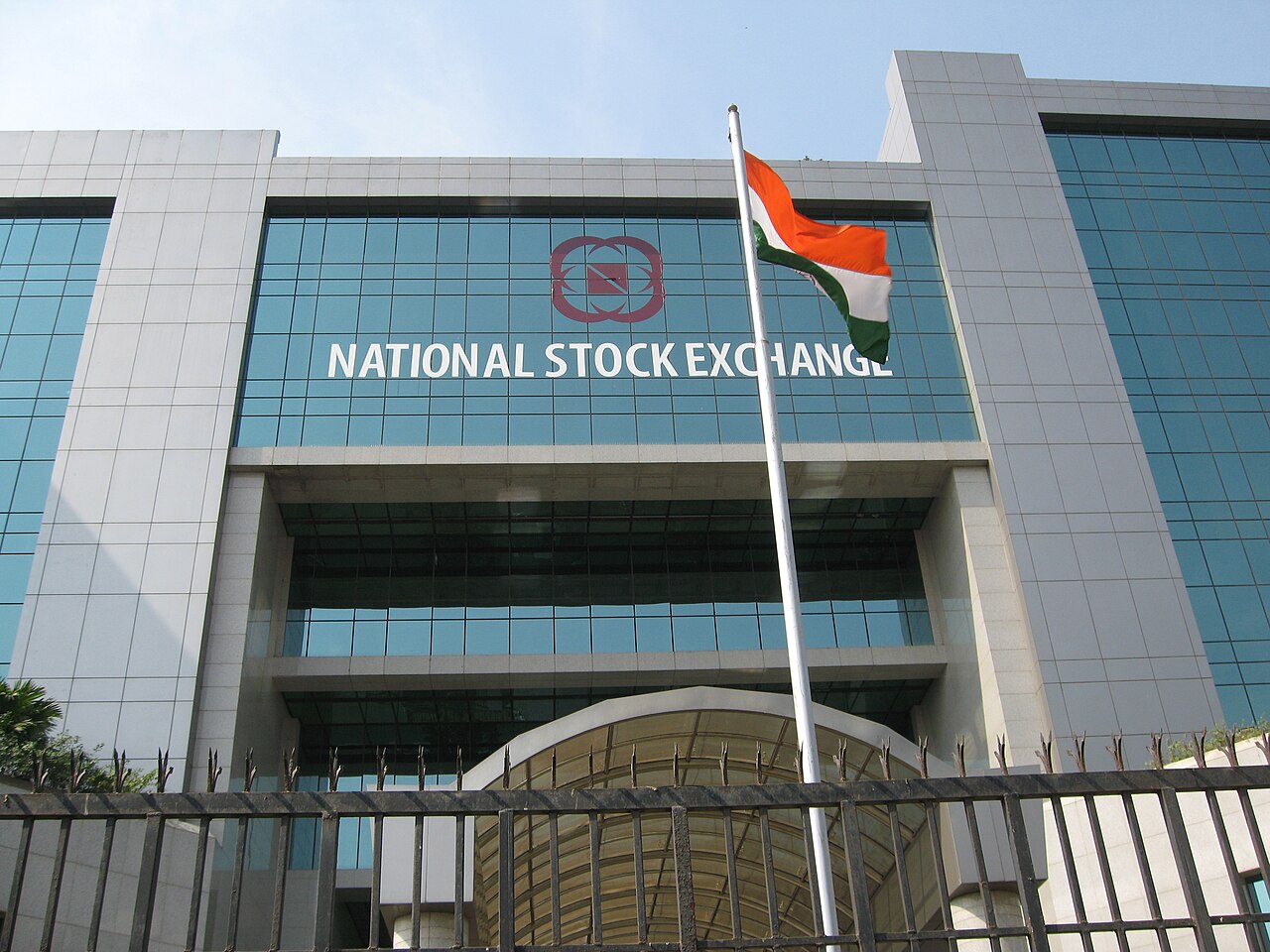
Separately, Jane Street and Elliott Management, also profiled in this series, jointly sued the London Metal Exchange over roughly $4 billion in nickel trades the exchange cancelled during the 2022 short squeeze. The High Court dismissed the case in 2023, an appeal failed in 2024, and the UK's Financial Conduct Authority fined the LME on its own in March 2025. And in February 2026, the manager overseeing Terraform Labs' bankruptcy estate sued Jane Street, alleging the firm's trading contributed to the 2022 collapse of TerraUSD and Luna; Jane Street moved to dismiss in April 2026.
None of the three has dented the firm's trading revenue so far. Whether that holds depends on how the SEBI appeal, the Terraform Labs suit, and any fallout from the LME case resolve, and none of the three is decided yet.
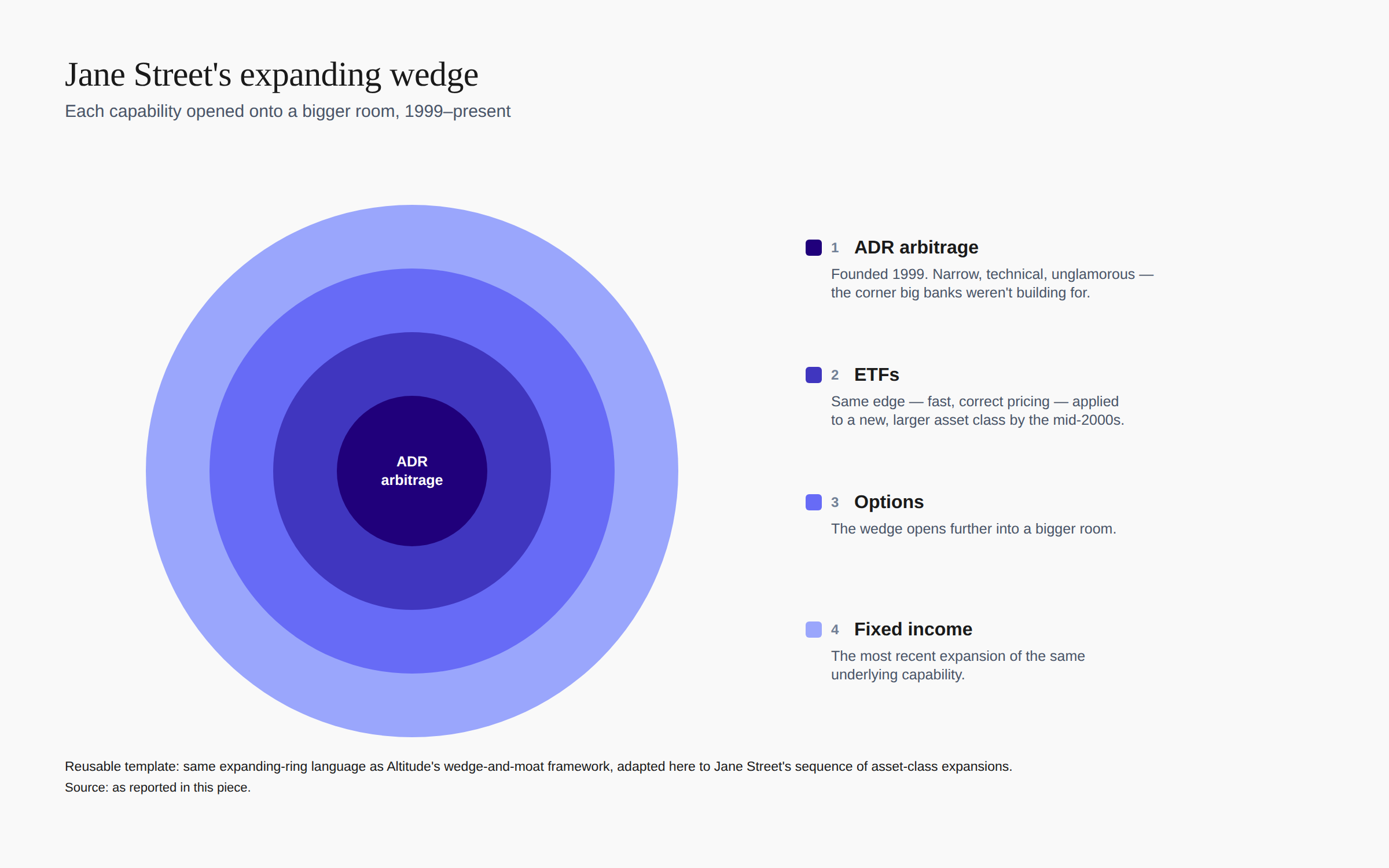
Four people, one small office, American depositary receipts. Tim Reynolds, Robert Granieri, and Michael Jenkins founded Jane Street on August 31, 1999, coming out of Susquehanna International Group, one of the original options-trading quant shops. Marc Gerstein, the fourth founder, came from IBM as a developer. The firm started narrow: trading ADRs, a specific, technical, unglamorous corner of the market that large banks weren't building specialized infrastructure for. It used that beachhead to fund a move into ETFs by the mid-2000s, then options, then fixed income, each expansion applying the same underlying capability, fast and correct market making, to a new asset class. That's a wedge that kept opening onto a bigger room, in the same sense the wedge and moat framework already developed in-house describes it (see What is a wedge and how to get one).
The culture that built it still runs on unusual terms for a firm this size. There is no CEO. An informal council of roughly 30 to 40 senior partners makes firm-wide decisions, and every employee is paid out of collective profits rather than an individual trading book. The technology stack is built almost entirely in OCaml, a functional programming language chosen specifically because it makes certain classes of error impossible to compile, not because it's the fastest option available. Python has crept in more recently for machine-learning work, but OCaml still runs the core. Headquarters sit at 250 Vesey Street in lower Manhattan, with offices across more than twenty countries. The firm describes its own structure, half seriously, as closer to an anarchist commune than a bank.

The ADR-to-ETF wedge wasn't the last time Jane Street used a narrow opening to get into a bigger room. In April 2022 it made its first direct investment in a DeFi protocol, and the following month it took a $25 million uncollateralized USDC loan through Clearpool, an institutional DeFi lending protocol, with BlockTower Capital as the lender and plans to scale the facility to $50 million. Clearpool called it the first time a major Wall Street institution had borrowed on a DeFi protocol, a claim that held up. A year later, in May 2023, Jane Street pulled back from US crypto trading alongside Jump Crypto, citing regulatory uncertainty in the wake of the FTX collapse.
FTX is worth naming directly rather than skipping past. Several former Jane Street traders, including Sam Bankman-Fried and Caroline Ellison, went on to found and run Alameda Research and FTX. The exchange's 2022 collapse is still the sharpest cautionary case in crypto history. It says nothing about how Jane Street itself operates. It says something real and checkable about how little a firm's hiring pedigree predicts about what a person does once they leave.
Non-bank trading specialists like Jane Street captured a record 26% share of global markets revenue in 2024, up from 12% in 2018. The forced-versus-chosen disclosure distinction from earlier in this piece applies across that whole shift, not just to this one firm. The firm disclosed real numbers for the first time only because a bond sale required a prospectus. Altitude's own investor-update template runs the other way, treating position-level disclosure as a standing commitment rather than a one-time filing obligation, a difference in when a firm decides to show its numbers, not a claim about whose numbers are better. July 2026 tested one specific thing: a concentrated, correlated bet, held through a fund Jane Street didn't fully control, invisible to the outside world until the month it wasn't. The market-making business, the part built over twenty-five years, never got tested at all.
Sources:
Jane Street's headquarters at 250 Vesey Street, part of the Brookfield Place complex, lower Manhattan. Source: Wikimedia Commons, "Brookfield Place New York August 2017 003.jpg" Credit: King of Hearts / Wikimedia Commons, CC BY-SA 4.0 License page: https://commons.wikimedia.org/wiki/File:Brookfield_Place_New_York_August_2017_003.jpg
Ken Griffin, founder and CEO of Citadel. Source: Wikimedia Commons, "Kenneth C. Griffin photo.jpg" — official portrait supplied directly by Citadel Enterprise Americas LLC (photographer Paul Elledge); Wikimedia's Volunteer Response Team verified Citadel's permission by email (VRT ticket #2021110910010233). Credit: Paul Elledge / Citadel, CC BY-SA 4.0 License page: https://commons.wikimedia.org/wiki/File:Kenneth_C._Griffin_photo.jpg
The National Stock Exchange of India building, Bandra Kurla Complex, Mumbai — home to the Bank Nifty index at the center of the SEBI case. Source: Wikimedia Commons, "National Stock exchange Mumbai.JPG," self-photographed and uploaded in 2007 (checked EXIF against the license — internally consistent, unlike another file in the same category that turned out to be a mistagged Bloomberg wire photo). Credit: Jnpet / Wikimedia Commons, CC BY-SA 3.0 License page: https://commons.wikimedia.org/wiki/File:National_Stock_exchange_Mumbai.JPG
10 Finsbury Square, London — the London Metal Exchange's headquarters since 2015, the building relevant to the nickel-trades case. (Not the London Stock Exchange, a separate building sometimes confused with it in stock-photo captions — the LME's previous Leadenhall Street building was also ruled out since it's the wrong building for the 2022 case timeline.) Source: Wikimedia Commons, "10 Finsbury Square, London.jpg," Flickr-reviewed Credit: Mark Hoogenboom, CC BY 2.0 License page: https://commons.wikimedia.org/wiki/File:10_Finsbury_Square,_London.jpg