 Altitude Development Partners
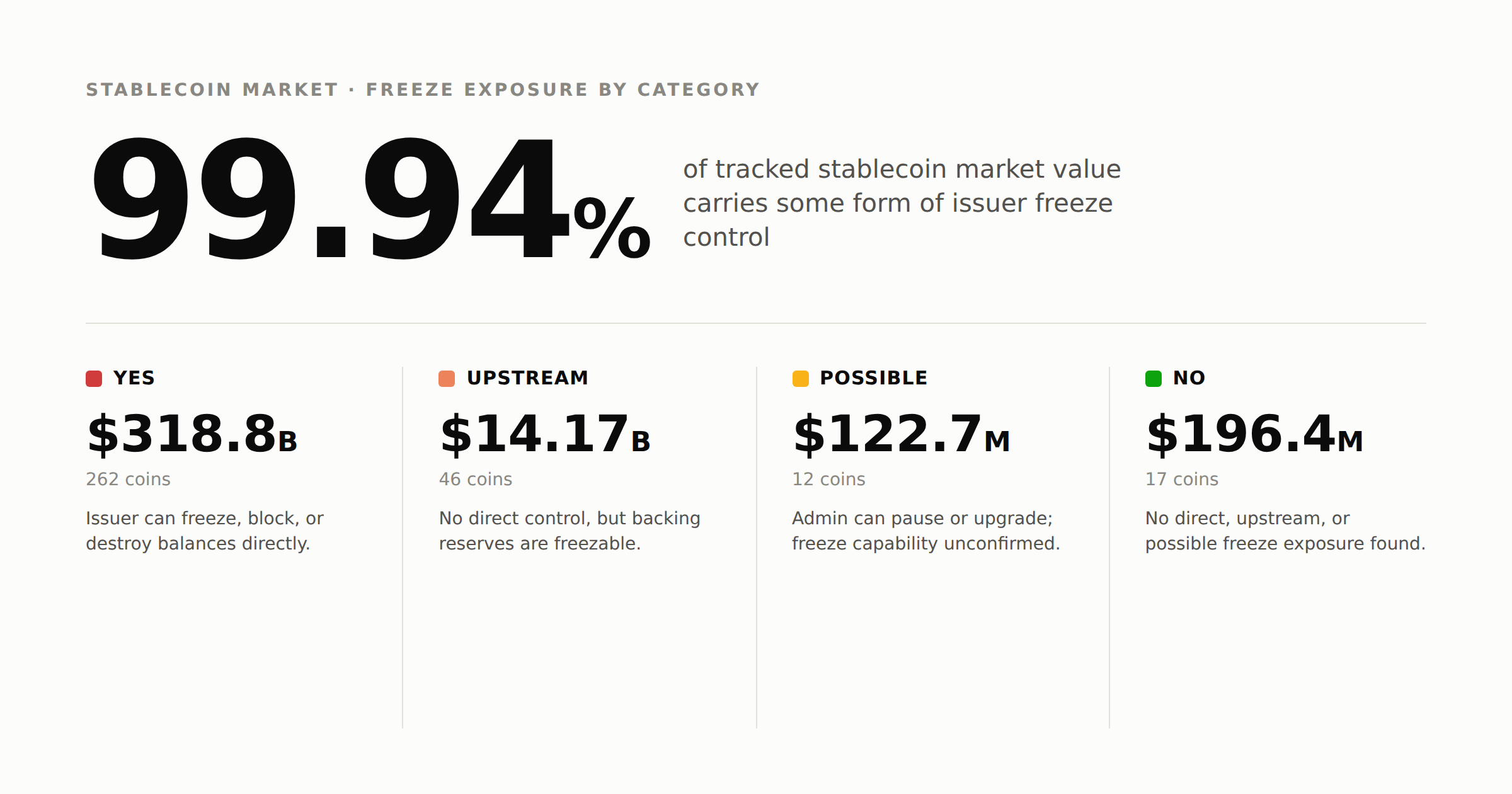 99.94% of the stablecoin market can be frozen by whoever issued it, in some form. That means someone at the issuing company has a function they can call that stops a balance from moving, or removes it entirely. The remaining 0.06%, about $196 million out of a $333 billion market, is the population of stablecoins where no such function exists.
That split runs straight through the two biggest stablecoins in circulation, not through some obscure corner of the market. It's worth being precise about what "freeze" actually means here, because the term covers a few different mechanisms that don't all work the same way or carry the same odds.
It's a function in a smart contract. Tether's contract ships with addBlackList and destroyBlackFunds. The first stops an address from moving USDT. The second removes whatever balance sits there, without needing a signature from the holder. USDC has an equivalent mechanism. This gets used regularly: Tether's blacklist currently lists 9,597 addresses, and the joint Tether-TRON-TRM Labs task force known as T3 has recovered more than $450 million through it since 2024, mostly in fraud and sanctions cases.
That version of a freeze: direct, contract-level, executed by the issuer alone is not the only version. A stablecoin can also carry freeze exposure indirectly, through the assets that back it, or hold an admin key capable of adding a freeze function later without having used one yet. Those are three distinct mechanisms with different likelihoods attached, which is why sorting a coin into a simple "freezable or not" bucket tends to miss the more useful distinction: which kind of freezable it is.
An independent tracker, pharos.watch, runs a project called FreezeWatch that classifies every stablecoin it tracks into one of four categories, based on what the contract and its backing actually allow:
Yes and No are the most straightforward to verify, since both are settled by reading documented, public contract behavior. Upstream and Possible describe a middle case: no confirmed direct control, but exposure that comes from somewhere else in the chain.
USDD, issued by TRON DAO Reserve, sits around $1.5 billion in market cap. Its contract has no publicly confirmed blacklist function comparable to Tether's, so placing it in Yes isn't supported by what's currently in the code. Its reserves, however, have historically included USDT and other centrally-issued assets, which do carry that function. No confirmed control at the token level, real exposure one layer up in the reserve: that's what the Upstream category is built to describe, with a Possible component from the administrative surface TRON DAO Reserve holds over the token itself.
The distinction is practical rather than academic. A coin backed by a freezable reserve inherits that reserve's exposure regardless of what its own contract says. If the backing asset is blacklisted, redemption is affected even if the token's own code has no freeze function at all. That's the difference FreezeWatch is drawing between "no direct control" and "no exposure."
Freeze functions mostly exist for a specific purpose: recovering funds tied to theft, fraud, or sanctions. The $993 million already recovered reflects that mechanism doing what it was built to do. The separate, useful fact is that price stability and freeze exposure are two different properties of a stablecoin, and knowing a coin's peg is stable tells you nothing about which of the four categories it sits in.
For anyone holding a stablecoin, that's a matter of knowing which category applies before assuming a balance behaves like cash. For anyone building a product on top of one, whether that's a payments rail, a lending market, or a token backed by someone else's reserve, the same four-category framework applies one layer up: what can affect your users' funds, and how many steps removed is it from your own contract. It's a straightforward check, and one most teams building on stablecoins haven't formally run against their own stack.
Freeze totals, blacklist counts, and category data are sourced from pharos.watch's FreezeWatch tracker and Tether's published blacklist records.
Freeze totals, blacklist counts, and category data are sourced from Pharos FreezeWatch tracker and Tether's published blacklist records.