 Altitude Development Partners
When Altitude was just starting out, I thought that the core objective of a business is to solve a problem, so I set out to solve all sorts of problems for other people and businesses. We created 3D models of construction sites using drone footage, built financial dashboards for real estate owner/operators, and even created a social app for friends to see each other on a map. Each time I set out on a new venture, I found myself struggling either to do sales, close deals, and even if I was able to close a deal I always struggled to make any money. What was the issue? My early ventures seemed to create a lot of value for the customers, and they said so themselves! Why was it so difficult to actually make a business out of it? Turns out solving problems wasn’t the only thing you need to worry about when building a business.
It has been 6 years since I started my first business, and I have now mastered the idea of a moat. But it can be easy to dismiss this as some sort of jargon, and to just focus on solving bigger problems or making more sales calls. This is the trap of the naive entrepreneur. A moat is a market force that has existed since the dawn of civilization, and one should ignore it at their own peril.
In the medieval times, feudal lords held deeds to land that was granted by kings. This land required serfs to farm the land in order to produce wealth. In exchange for their work, serfs received protection and a place to live. Let’s imagine that the grain produced by the serfs created $1000 in profits, the serfs themselves got to keep only enough to survive, while the lord received the rest. Fundamentally, what made the lord more able to keep the wealth than the serfs? The lord has a moat in the form of the land deed while the serfs merely create value with their time and effort. In the example, time and effort, as well as the produced crop, are abundant resources and are easily replicable, however the deed is a scarce resource which was not replicable easily without a military conflict or revolution. This model shows the fundamental difference between “Created Value” and “Added Value” where the created value is the amount of wealth that was produced using time and effort, while the added value represents the amount of wealth that would be lost if something would disappear. The difference between the two measures the replicability of an asset, business, or individual. In the medieval example, the feudal lords’ deed has mostly added value in the form of the land deed, where if the land was to disappear or be destroyed, then all the downstream wealth of that land would also disappear. On the other side, the serfs individually have mostly created value in the form of the crop they produce but no added value because individually they are easily replaced.
Today we are not talking about whether it is right or wrong for such advantages to exist, but we are merely talking about the existence of this type of market asymmetry. Also it is important to note that the free market economy grants many more opportunities to individuals today than it did during the medieval times, however the idea of a “moat”, however it may have been called in the past, is a fundamental market force that will never disappear.
Brandenburger & Stuart’s formal definition: added value = the value of the system with you in it minus the value without you.
At this point we have established that the idea of a moat is not a jargon term invented by silicon valley VCs to trip up startup founders. The companies and individuals with a moat take the majority of the profits due to their unique advantage not easily replicated by others. Without a moat, participants in an economy are only able to capture strictly enough value to survive using only the wealth created by their time and effort, and no more. Modern examples of market participants with no moat are all the “gig economy” workers. Ride sharing drivers, delivery drivers, call center employees, factory workers, maintenance technicians, and now, with AI, software engineers are also gig economy workers. Those who fail to build a moat will simply pass the profits down to the customers in the form of cost savings and commoditization, or they will pass the profits up to the moated holders of scarce resources.
Now it is clear. No moat = poor for the rest of your life. No matter how many problems you solve or how much value you create, this rule will be true. So how can each of us create a moat? Is it even possible?
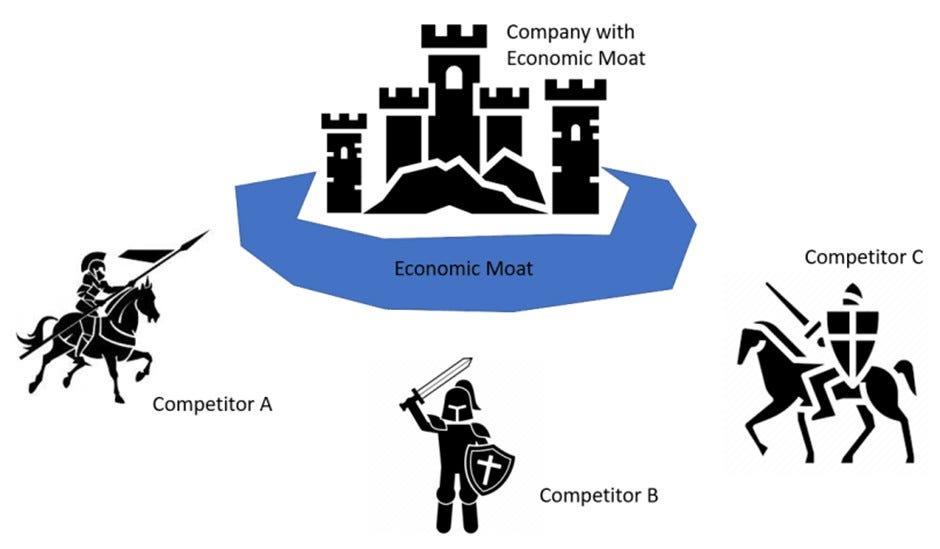
The root principle: value capture requires that your removal destroys value AND that no one can replicate your contribution at competitive cost. Many people when starting a business think they just need to build another Facebook, or another PayPal. They tend to only realize their mistake by the time they spent 10 months building their product. But then, since they are easily replaceable, they can only capture the incremental value of their own time and effort. On the flipped side of the coin, the same fate awaits all the people who come up with an idea that is completely new and nobody understands the purpose of what they’re building. They may not be easily replaceable, however no value would be destroyed if they just quit what they’re doing. A true moat hides somewhere in between the two extremes, where the business is not easily replaceable and a lot of value would be lost if they were to quit. It seems obvious when stated this way, but businesses that can’t make any money fail exactly here.
So what kind of mechanics could help a business build their moat over time? And by the way, over time is the only way to do it. A moat that was built overnight is no moat at all.
The first set of examples are demand-side moat mechanisms where the customer can’t leave.
Switching costs — embeddedness in workflow, data migration pain, retraining cost. The strongest version is when your output becomes their input format.
Network effects — each user raises the value to others. Includes data network effects, the weaker cousin.
Brand as risk reduction — in relationship-gated markets, trust is the scarce input. “Nobody got fired for hiring X.”
demand-side moats become stronger as the business obtains more customers. Businesses with this kind of moat have the advantage of reduced cost of sales but this moat takes years, if not decades to build.
Then there are the Supply-side mechanisms (competitors can’t match your cost or capability)
Proprietary data flywheels — usage generates data that improves the product, compounding faster than entrants can catch up. Only works if the data is genuinely exclusive and the improvement curve hasn’t flattened.
Scale economies — fixed costs amortized over volume.
Cornered resource — exclusive access to an input: talent, deal flow, a dataset, a relationship network.
Process power — organizational capability that’s tacit and slow to copy (Teece’s point: when imitation is easy, value flows to holders of scarce complements).
Supply-side moats can be built over a shorter period of time, but often require a lot more effort to establish with intensive capital expenditures. Also, supply-side moats often need the founders to have exclusive access to a significantly limited resource (kind of like the feudal lords did)
And finally there are the positional mechanisms
Control of the customer interface — Whoever owns demand commoditizes everyone behind them. Varoufakis’s “cloud capital” is this: platforms don’t compete in markets, they own the market.
Counter-positioning — a model incumbents can’t copy without destroying their existing economics.
Conversion of flows into stocks — Recurring revenue, owned audiences, capitalized IP. A stock is anything that earns while decoupled from your hours.
These are the holy grail of becoming a tech billionaire, with #10 being the IPO exit that makes the time and effort of the Founder/CEO a completely separate driver of wealth from the stock they own.
As we discussed above, one of the challenging things about moats is that a business must build it over time, and it often takes years, decades even, to get right. So it’s best not to get discouraged if you don’t have a moat right now, the most important thing is to focus on the direction of your moat. Is it growing? Is it shrinking? As long as this is a constant project on your to-do list, in 10 years you will find yourself irreplicable and irreplaceable in the economy. Read more about Precedents and Superlatives to learn how to get other people excited about the idea of you having the moat that sets you apart from others.
The studio/agency/consulting/project/gig model has, by default, zero added value in the formal sense. Clients can route around you, and your comp is tied to time. That’s serfdom at the firm level, regardless of margins. If you’re building a business and want to capture more value, ask yourself this. What stock does this flow leave behind? Proprietary data, a reusable product, an owned relationship, or nothing. If nothing, you’re farming someone else’s land, however good the harvest.
Read more from Altitude on our website.
What is a moat and how to get one was originally published in Altitudedp on Medium, where people are continuing the conversation by highlighting and responding to this story.