 Altitude Development Partners
I used to think the hardest part was building the product.
It’s not. The hardest part is getting the first person to actually use it.
You launch the product and maybe 12 people sign up, 3 of them are your friends, and the other 9 never log in again. I’ve been there. It feels like the product is broken.
What changed everything for me was running a founding user program. A real, structured effort to recruit a small group of people, give them something real, and build an actual relationship with them.
Here’s what I learned.
The instinct is to get as many users as possible as fast as possible. More data, more feedback, more validation. But early on, the volume is just a noise.
What you actually need is depth. 20 people who genuinely use your product, talk to you honestly, and care enough to come back next week. That’s infinitely more useful than 500 signups who ghost you after day one.
When I narrowed my focus to a small group, everything got clearer. The feedback was sharp and real…and I actually knew their names.

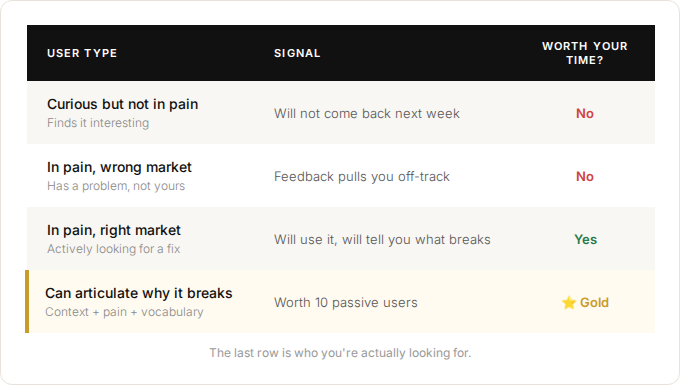
Not everyone makes a good founding user. I made the mistake of taking anyone who showed interest. Some were curious, but not in pain. Others were in pain but not in your market... Both are a waste of your time and theirs.
The profile I look for now: someone who has the exact problem you’re solving, is actively looking for a solution, and has enough context to give you useful feedback. A user who can articulate why something doesn’t work is worth 10 who just say “it’s confusing.”
Find these people in Slack communities, LinkedIn with altitude-based filtering by role and seniority, or through direct referrals from the first few people you speak to.
People are busy. If you want someone to invest time in your early product, you have to give them something real in return.
What works: lifetime pricing locked in, early access to features they asked for, a direct line to you as a founder, or a genuine co-creation role. A 30-day free trial that anyone can get, or vague promises about being “part of the journey,” will not hold anyone. Founding users are taking a bet on you. The offer should match that.
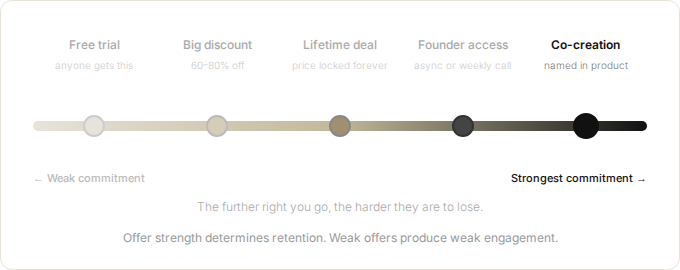
This is where I failed the first time. I onboarded people, they used the product for a week, I didn’t follow up, and they quietly disappeared.
Founding users disengage fast when they feel like a number in your analytics dashboard. You need a Slack channel, a weekly check-in or something that keeps the relationship alive. And when you ship a feature because of something they said, tell them!! That moment of recognition keeps people invested longer than any pricing incentive.

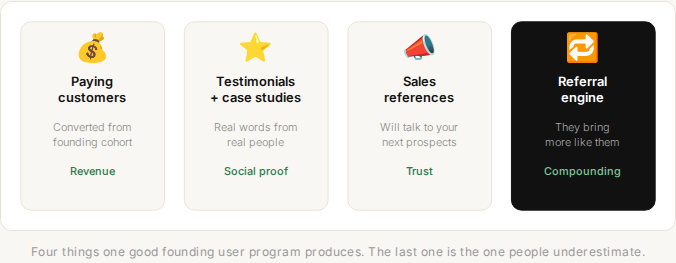
After 60 to 90 days, the program should have given you paying customers, real testimonials, and a few people who will take a call with your next prospect and say good things.
But the relationship doesn’t end there. The founding users who had a great experience become referral sources, case study subjects, and sometimes your best salespeopl…without ever being on your payroll. The ones I stayed close to have referred more customers than any campaign I’ve run.
Stop trying to reach everyone. Find 20 people who have the exact problem you’re solving, make them a real offer, and treat the relationship like it matters …because it does!!
You don’t need a growth strategy in the first 90 days. You need 20 people who actually care what you’re building.
Start there.
Build the relationship before you need it. By the time you’re pitching your Series A, your founding users should be one of your strongest assets.
I work as CMO at AltitudeDP, where a lot of what I write about gets tested in practice. If you’re building something early-stage and want to talk through your go-to-market, I’m always open to a conversation!
The Hardest Part of Starting a Startup Nobody Talks About was originally published in Altitudedp on Medium, where people are continuing the conversation by highlighting and responding to this story.