 Altitude Development Partners
The conventional explanation for startup failure runs through capital. CB Insights’ review of 483 startup post-mortems found that running out of cash appears in roughly 70% of cases, but the same research now classifies cash exhaustion as a symptom, not a root cause. Beneath it, 42–43% of failures trace back to “no market need,” and 23% to team problems. The proximate cause is the empty bank account; the underlying cause is almost always a product that never sharpened into something a market actually wanted.
What gets less attention is how a clear idea becomes an unclear one. Founders rarely begin without a market thesis. They begin with one, and then lose it, often within months, almost always before they recognize what they’ve lost. The question worth asking is not why ideas fail. It is why they blur.
Thanks for reading Altitude Development Partners! Subscribe for free to receive new posts and support my work.
This article makes the case that the dominant early-stage failure mode is not execution, capital, or even product-market fit in the abstract. It is entropy, the slow, reasonable-feeling erosion of the original wedge under the cumulative weight of new inputs. And it argues that the most consequential new tooling for founders is not generative AI in its now-familiar forms, but the emerging category of agentic systems built specifically to enforce vision discipline.
The closest analog outside the founder world is the project management literature, where scope creep is one of the most studied failure modes. PMI’s Pulse of the Profession 2018 found that 52% of completed projects experienced scope creep or uncontrolled scope changes, up from 43% just five years earlier. The same body of research identifies unclear requirements as the contributing factor in 39% of project failures, with scope creep ranking as the third leading cause overall, behind only shifts in organizational priorities and shifts in project objectives.
Later PMI data reinforces the operational pattern. Only 30% of highly mature project organizations report scope creep on a given project, versus 47% of low-maturity organizations, a 17-point gap driven almost entirely by the presence or absence of explicit scope-governance infrastructure.
The implication for early-stage builders is not subtle. Even in environments where project boundaries are explicit, contracted, and reviewed weekly, scope drifts in more than half of cases. A founder’s environment provides none of those guardrails. The “project boundary” exists only in the founder’s head. Every customer call, competitor launch, and investor question is an implicit, authorized request to revise it.
Drift, in this context is the default, and it’s deadly.
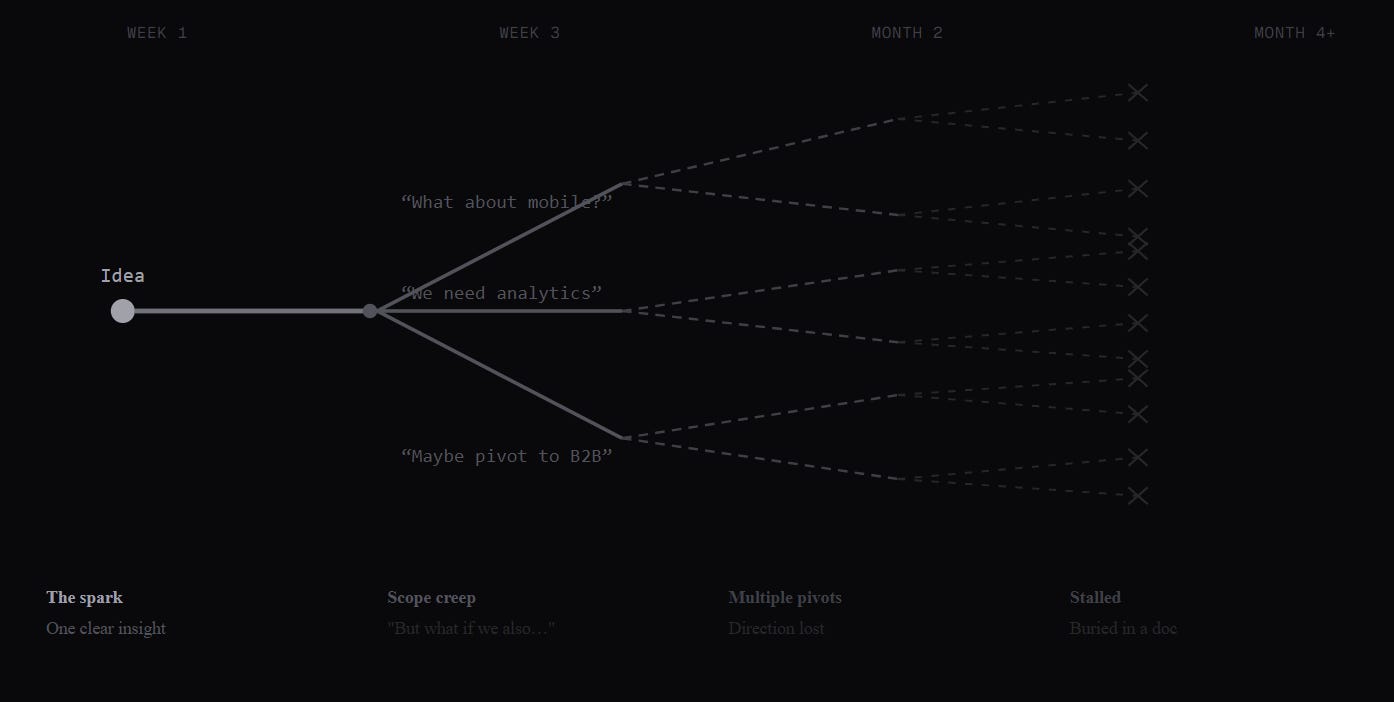
The standard advice — say no, stay focused, ignore the noise — collapses on contact with the actual conditions of building a company. Founders are not undisciplined, they actually are quite disciplined towards seeking opportunities. Early-stage product development requires absorbing new information faster than mature operations do. Cutting off that flow actually reduces innovative thinking and competitiveness.
Research on founder behavior reinforces the operational cost. Reviews of unicorn-founder routines find that more than half of them block off three or more hours of uninterrupted deep work per day. It is a system built against distraction. Without it, every new input becomes a context switch, and every context switch is a small subtraction from the vision the founder started with.
The corporate analog is well-documented. Survey data finds that only about 10% of organizations achieve two-thirds of their strategic objectives, and over half achieve less than 50%. Many attribute this to strategy failure, but forget that it’s really execution discipline against drift.
The most interesting development in this space is the emergence of agentic systems. Today, agents can maintain an ongoing operating discipline on behalf of the CEO.
McKinsey’s State of AI in 2025 report frames the trend in scale: 62% of organizations are now experimenting with AI agents, though only 23% have scaled them in any function. Industry forecasts referenced in the same body of research project that by 2028, roughly 15% of day-to-day work decisions will be made autonomously through agentic systems, up from effectively zero in 2024.
The application of this pattern to founder workflows is underexplored. Most “AI for founders” tooling has so far fallen into two buckets: retrieval (better answers) and generation (faster drafts). What has been largely missing is the third category: governance. An agent whose job is not to produce more output, but to enforce the operating constraints a founder lacks the cognitive bandwidth to enforce themselves.
This is the category KORA is built for.
KORA frames the founder journey as a sequence of gates. The first gate, Vision Architect, is a structured 60–90 minute session built around eight questions a sharp co-founder or chief of staff would ask: wedge sentence, target customer, specific pain, why now, and four others that surface where the actual idea lives versus where the founder has been drifting.
The output is two artifacts:
A one-page vision document — short, defensible, and shareable to a co-founder, first hire, or first investor.
A deferred ideas log — every adjacent thought surfaced during the session, captured, dated, and held for future gates.
The second artifact matters more than it sounds. Most focus tooling tells founders to ignore new inputs. KORA’s premise is the opposite: capture every input, but separate capture from commitment. Deferred is not dismissed. It is sequenced.
This is consistent with what the founder-market fit literature suggests about clarity. Research summarized in the founder-market fit body of work indicates that founders with strong founder-market fit are roughly 230% more likely to scale than those without. Vision documents that survive contact with reality are documents written at that resolution. KORA’s session is designed to force that resolution under time constraint.
The system’s gate architecture extends sequentially: Gate 2 (business model), Gate 3 (MVP scope), Gate 4 (launch planning), Gate 5 (early traction). The ordering is the point. Most founders attempt all of these in parallel and end up with a beautifully scoped MVP for a vision they cannot articulate.
A balanced view of any agentic system requires acknowledging its limits. Three are worth naming.
The first is garbage in, garbage out. A forcing function can only refine what the founder brings to it. If the input is a thinly imagined idea, the output is a more clearly stated thinly imagined idea. KORA cannot manufacture insight, but it can only structure insights provided by the user.
The second is false closure. The risk of producing a polished one-page artifact is that founders treat it as the answer rather than as a hypothesis. The vision document is meant to be defended and revised. The discipline of returning to it at subsequent gates is part of how the system mitigates this by placing real responsibility on the founder.
The third is automation bias. McKinsey’s adoption data is instructive here: less than 10% of organizations have scaled AI agents in any single function, partly because operators over-trust well-formatted outputs from systems they do not audit. The same caution applies to founders. The point of an agentic CEO is not to outsource judgment. It is to make judgment cheaper to apply, more often, against a more stable artifact.
The honest framing is that agentic discipline systems amplify capable founders and expose weak ones. They are not a substitute for the underlying work.
A useful tool produces a durable artifact. A session that ends without something the founder can send to a co-founder, hire, or investor is a session that did not compress anything.
A useful tool captures what it rejects. Tools that demand focus by suppressing inputs lose the inputs. Tools that defer inputs preserve optionality.
A useful tool imposes a sequence. Tools that let the founder address every dimension in parallel are surface-level tools.
A useful tool survives contact with the real founder workflow. A discipline tool used once is a journal entry. A discipline tool returned to at each gate is infrastructure.
The pattern across these criteria is consistent: agentic discipline is about giving the founder a structure that keeps the original idea legible ... to themselves, to their team, and to the people they need to convince. A lack of discipline falls to entropy.
The most counterintuitive lesson from a decade of startup failure research is that the founders most likely to succeed are not the ones with the most ideas. They are the ones with the most resolved ideas. Those who can name the customer, the pain, and the wedge in a single sentence, and who can keep doing so under the constant pressure of new inputs are the winners.
For most of business history, that discipline lived in human form, whether a sharp co-founder, a patient chair, a chief of staff who would not let a vague answer survive a meeting. Most founders, especially solo or pre-seed, do not have access to those people.
What they increasingly do have is access to systems that can play the same role. KORA is one. It will not be the last. The founders who treat agentic discipline as infrastructure will compound an advantage in the form of an idea that does not blur.
The original wedge is the most valuable thing a founder has. It is also the most fragile. The work, increasingly, is building the system that keeps it intact.
Try KORA → https://agentic-ceo.vercel.app/
See what else Altitude Built for you → https://www.altitudedp.com/
Correspondence: nikolai@altitudedp.com
PMI — Pulse of the Profession 2018: Success in Disruptive Times
McKinsey — The State of AI in 2025: Agents, Innovation, and Transformation
WinSavvy — How Founders Spend Their Time: Habits That Predict Success
Thanks for reading Altitude Development Partners! Subscribe for free to receive new posts and support my work.